

Linear Regression in Machine Learning
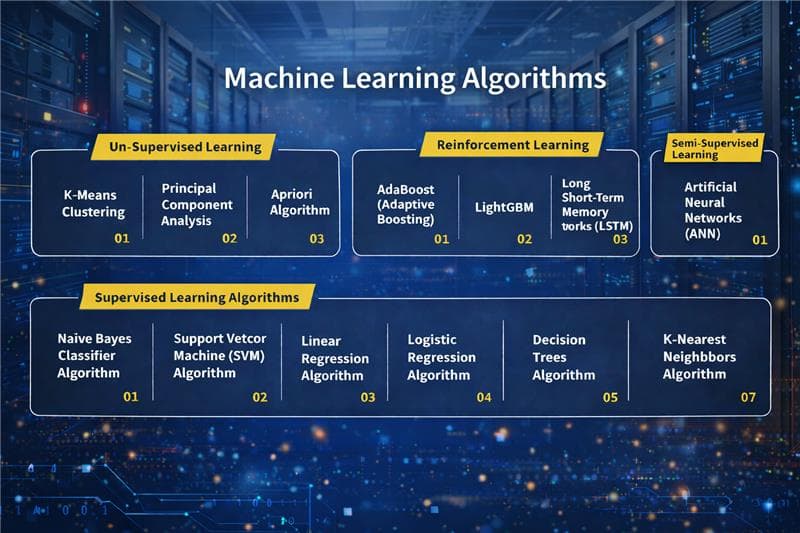
Linear Regression is a commonly used algorithm in Machine Learning that is also very intuitive. It is a statistical technique that describes the relationship between a dependent variable and one or more independent variables. This algorithm is widely used in predictive analytics, data analysis, and business forecasting.
Its main advantages are simplicity, easy interpretation, and efficiency, which is why it is widely used by both beginners and experienced data scientists.
What is Linear Regression?
Linear Regression works by fitting a line through a cloud of points to find an equation that links the dependent variable with the independent variables. It is used for predicting the value of a continuous variable such as sales, stock prices, or patient recovery time.
The model adjusts the coefficients to minimize the error between predicted and actual values, producing a best-fit line that represents the overall data pattern.
Understanding Linear Regression
Linear regression is a straightforward example of supervised learning. The model learns from labeled data and figures out the linear dependency between inputs and a target variable by minimizing the sum of squared prediction errors.
For example, a company can use linear regression to predict monthly sales based on advertising spend, resulting in a simple formula that supports clear decision-making.
The Principle of Linear Regression
Linear regression assumes that changes in a dependent variable can be explained by a linear relationship with independent variables. While real-world relationships are sometimes more complex, linear regression provides a reliable first approximation for many problems.
Mathematical Foundation
A simple linear regression model can be expressed as:
y = mx + c
- y is the output variable (dependent variable)
- x is the input feature (independent variable)
- m is the line's gradient
- c is the y-intercept
Cost Function and Optimization
The Mean Squared Error (MSE) is commonly used to quantify model fit by averaging squared differences between predictions and actual values. Gradient Descent then iteratively updates parameters to minimize this error until an optimal set is reached.
Role of Gradient Descent
Gradient Descent is a key optimization technique that minimizes the cost function. It becomes essential when datasets are large and calculating parameter estimates analytically is computationally expensive.
Types of Linear Regression
- Simple Linear Regression: One independent variable; highly interpretable.
- Multiple Linear Regression: Several independent variables for more precise predictions.
- Regularized Linear Regression: Ridge and Lasso add penalties to prevent overfitting.
Applications of Linear Regression
- Finance: Forecast stock prices or returns over time.
- Healthcare: Estimate survival durations and treatment efficacy.
- Marketing: Analyze campaign effectiveness and customer behavior.
- Business Forecasting: Project sales, revenue, or product demand.
Advantages and Limitations
Pros: Simple to implement, fast to compute, and easy to interpret.
Cons: Assumes linear relationships, is sensitive to outliers, and performs poorly on complex nonlinear data.
Conclusion
Linear regression is a foundational algorithm in Machine Learning. Its simplicity, efficiency, and interpretability make it an excellent starting point for predictive modeling and a benchmark for more advanced techniques.
When its assumptions are met, linear regression delivers dependable insights that help stakeholders make informed decisions across finance, healthcare, marketing, and business analytics.
Explore More: Read the broader overview in What is Machine Learning? A Comprehensive Guide