

Table of Contents
The New Software Stack: Incorporating Generative AI at Every Level of Development
Introduction
Rapid advances in artificial intelligence are redefining the foundations of software development. Generative AI is moving from an optional tool to a core capability embedded across the modern software stack—shaping how applications are designed, built, tested, deployed, and optimized.
Understanding the New Software Stack
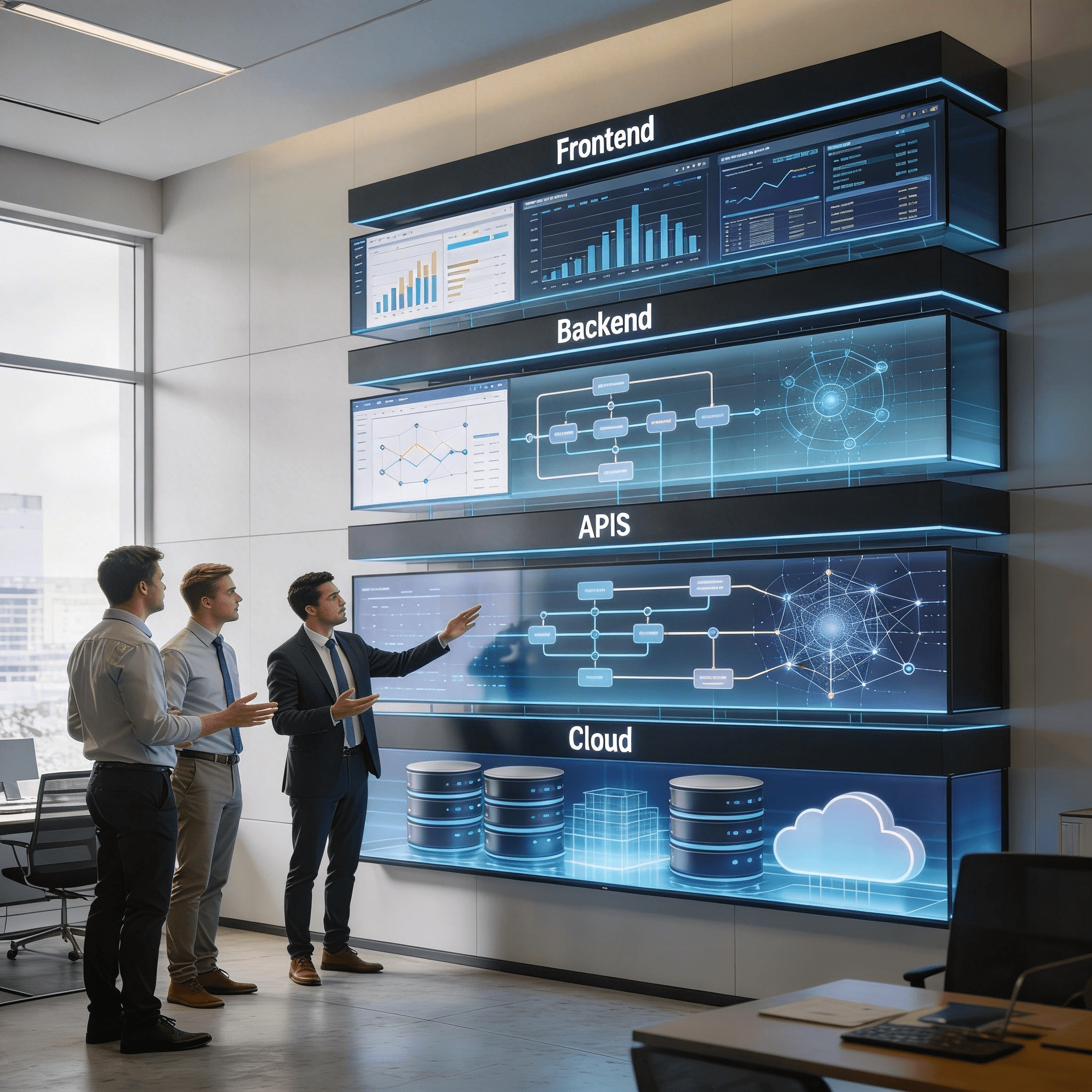
Traditional stacks separated frontend, backend, databases, and infrastructure. Generative AI introduces an intelligent layer that touches every other layer—accelerating tasks, improving quality, and enhancing developer experience.
Traditional vs. AI-Driven Architecture
Instead of static roles, AI-driven stacks embed automation and learning directly into workflows. Generative AI assists with code authoring, database queries, and UI design, making the entire stack smarter and more efficient.
Role of Generative AI
- Automatic code generation
- AI-assisted bug fixing and refactoring
- Natural-language development interfaces
- Performance forecasting and analysis
Embedding AI Across Development Layers
Generative AI improves each layer:
- Frontend: Auto UI design, layout suggestions, and content generation.
- Backend: API generation, logic optimization, and pattern discovery from large datasets.
- Database: Schema recommendations, query analysis, and workload predictions.
- DevOps: Pipeline automation, monitoring, and failure prediction to improve resilience.
Benefits of Integrating Generative AI
- Increased Productivity: Automates repetitive tasks; accelerates coding and debugging.
- Enhanced Innovation: Frees teams to focus on advanced problem-solving and design.
- Improved Accuracy: Real-time validation reduces errors and raises code quality.
- Scalability: Adapts to complex workloads and maintains performance under growth.
Challenges and Considerations
- Data Privacy & Security: Ensure compliance and protect sensitive data used for model training.
- Model Reliability: Validate outputs and maintain models post-deployment.
- Skill Adaptation: Upskill teams to work effectively with AI-enabled tooling.
Future Outlook
- AI-Native Development: Systems designed with AI at the core—not as an add-on.
- Human–AI Collaboration: Humans steer high-level decisions while AI executes routine and complex tasks.
- Continuous Learning: Stacks evolve via feedback loops and dynamic models.
Conclusion
Incorporating generative AI across the software stack marks a lasting shift in how applications are engineered and improved. While challenges remain, the gains in efficiency, innovation, and scalability position generative AI as a cornerstone of modern software development.